
Table of Contents
- Why Neurodivergent App Marketing is the Next Big Growth Lever
- The Sensory-Friendly Approach to Ad Creatives
- Clear Communication: The Anti-Hype Copywriting Strategy
- Notification Hygiene: Marketing Without the Anxiety
- Gamification vs. Overstimulation: Finding the Balance
- Case Studies: Apps Getting it Right
- Conclusion: The Future is Inclusive
- Frequently Asked Questions
Neurodivergent app marketing is not just a buzzword; it is the single most overlooked opportunity in digital growth today.
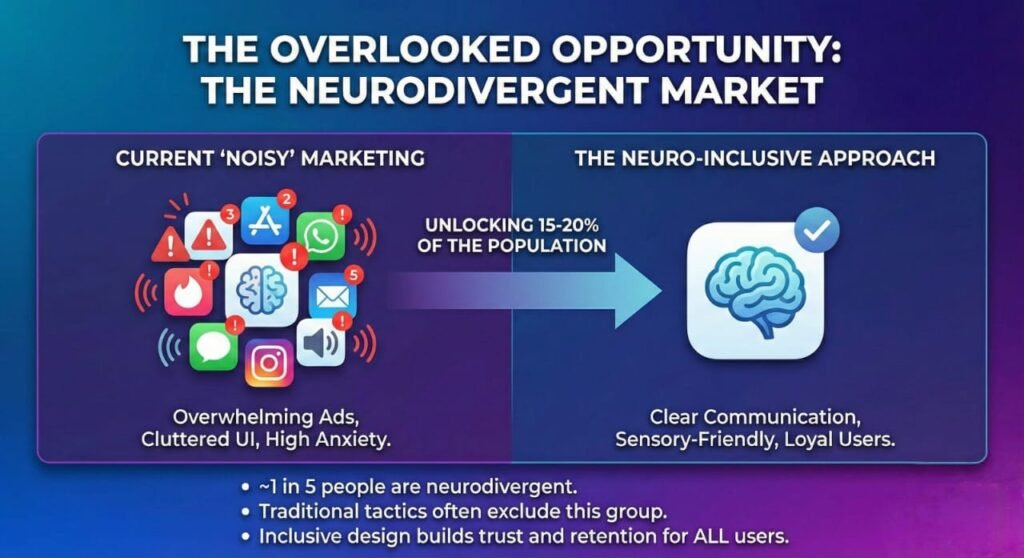
When we think of accessibility in marketing, we often limit our scope to font sizes or color contrast for visual impairments. While crucial, this ignores a massive demographic: the neurodivergent community. This group includes individuals with ADHD, Autism, Dyslexia, and other cognitive variations—making up an estimated 15-20% of the world’s population.
If your marketing strategy relies on flashing lights, vague metaphors, or high-pressure “FOMO” (Fear Of Missing Out) tactics, you aren’t just annoying users; you are actively driving away nearly one-fifth of your potential market.
In this guide, we will explore how shifting to neurodivergent app marketing strategies can lower your churn, increase brand loyalty, and open up a “Blue Ocean” of untapped users who are desperate for digital experiences that respect their brain function.
Why Neurodivergent App Marketing is the Next Big Growth Lever
The digital world is noisy. For a neurotypical brain, a pop-up ad might be a nuisance. For a neurodivergent brain, it can be a barrier to entry.
Neurodivergent app marketing focuses on clarity, predictability, and sensory control. By optimizing for these traits, you inadvertently improve the user experience (UX) for everyone. This is known as the “Curb-Cut Effect”—when you design for disability, you benefit society as a whole.
Consider the modern app ecosystem. It is filled with dark patterns, hidden cancel buttons, and aggressive red notification badges. These tactics might squeeze out short-term conversions, but they destroy long-term trust. Neurodivergent users are often the “canaries in the coal mine.” If your app overwhelms them, it is likely stressing out your neurotypical users too—they just haven’t deleted you yet.
By prioritizing neurodivergent app marketing, you signal that your brand is safe, transparent, and user-centric. This builds the kind of deep loyalty that paid ads simply cannot buy.
The Sensory-Friendly Approach to Ad Creatives
The first interaction a user has with your app is usually an ad on Instagram, TikTok, or YouTube. Traditional marketing wisdom says: “Make it pop! Use loud music! Cut fast!”
In neurodivergent app marketing, this “shock and awe” approach often backfires.
1. Avoid Auto-Play Audio Surprises
For users with sensory processing sensitivities, unexpected loud audio is physically painful. Ensure your video ads start silent with clear captions. If sound is necessary, use a “Fade-In” effect rather than an abrupt explosion of noise.
2. Reduce Motion Sickness Triggers
Parallax scrolling and rapid-fire editing can trigger motion sickness or vestibular disorientation. A neuro-inclusive ad creative focuses on linear storytelling. Show the app’s interface clearly. Don’t hide the product behind flashing transitions.
3. Use Calming Color Palettes
High-contrast neon colors can be overstimulating. Neurodivergent app marketing often favors “Dark Mode” aesthetics or pastel palettes that convey a sense of calm and order. If your app is a productivity tool, market the peace of mind it brings, not just the speed.
Clear Communication: The Anti-Hype Copywriting Strategy
Ambiguity is the enemy of conversion. This is especially true in neurodivergent app marketing, where users often prefer literal, direct communication over metaphors or sarcasm.
Literal Value Propositions
Avoid vague slogans like “Crush your day!” or “Be a rockstar!” instead, use literal descriptions of what the app does.
- Bad: “Unlock your potential.”
- Good: “Organize your tasks by priority and due date.”
The “Plain Language” Standard
Use bullet points and bold text to break up walls of text (just like this blog post!). Dyslexic-friendly formatting includes using sans-serif fonts and avoiding italics, which can make letters appear to “crowd” together.
When writing your App Store description, prioritize structure. Users with ADHD often scan for information. If they cannot find the pricing model or key features in 5 seconds, you have lost the download.
Notification Hygiene: Marketing Without the Anxiety
Push notifications are a powerful retention tool, but they are also a major source of anxiety. Neurodivergent app marketing requires a complete rethink of how and when we ping users.
The “Batch” Notification Feature
Instead of sending five separate notifications throughout the day, market a feature that allows users to “Batch” them into a single evening summary. This puts the user in control and reduces the cognitive load of constant interruptions.
Emotional Neutrality in Copy
Avoid “shame-based” re-engagement copy.
- Aggressive: “You’re losing your streak! Don’t let your team down!”
- Inclusive: “Your daily lesson is ready whenever you are.”
Shame triggers rejection sensitive dysphoria (RSD), a common trait in ADHD. By using neutral, supportive language, your neurodivergent app marketing strategy fosters a safe environment where users feel encouraged, not judged.
Gamification vs. Overstimulation: Finding the Balance
Gamification is a staple of app growth. However, badges, leaderboards, and streaks can become obsessive or overwhelming for some neurodivergent users.
To succeed in neurodivergent app marketing, you must offer “Opt-Out” mechanics.
The “Zen Mode” Option
Market a “Zen Mode” or “Focus Mode” that hides leaderboards and streak counters. This allows users to enjoy the utility of your app without the pressure of social comparison.
Predictable Rewards
Random intermittent rewards (like slot machines) are addictive but can cause distress or hyper-fixation. Transparent reward systems—where the user knows exactly what they need to do to earn a badge—are far more effective for building sustainable habits.
![Screenshot of an app interface optimized for neurodivergent app marketing with a clean layout]](https://emirareach.com/wp-content/uploads/2026/01/WhatsApp-Image-2026-01-16-at-7.49.46-PM-1024x558.jpeg)
Case Studies: Apps Getting it Right
Let’s look at two examples of brands effectively utilizing neurodivergent app marketing principles, even if they don’t explicitly label them as such.
1. Goblin Tools
This AI-powered to-do list app went viral on TikTok specifically because it targeted the neurodivergent community. Its “Magic To-Do” feature breaks down overwhelming tasks (like “clean the kitchen”) into tiny, manageable steps. Their marketing is entirely focused on reducing executive dysfunction, not “hustle culture.”
2. Discord
While chaotic for some, Discord allows granular control over notifications. Users can mute entire servers, specific channels, or suppress @everyone pings. This level of user agency is a core pillar of neurodivergent app marketing. They market the customizability of the experience, empowering users to curate their own sensory environment.
Conclusion: The Future is Inclusive
The era of aggressive, noisy, and manipulative marketing is fading. Users are becoming smarter, and their tolerance for digital clutter is at an all-time low.
Adopting neurodivergent app marketing strategies is not just about checking a diversity box. It is about building a product and a brand voice that respects the user’s time, attention, and mental energy. When you design for the neurodivergent brain, you create a cleaner, clearer, and more effective experience for every single user.
Start small. Audit your push notifications. Simplify your ad creatives. Be literal in your copy. The results will not only show in your engagement metrics but in the loyalty of a community that finally feels seen.
Frequently Asked Questions
What is the most important element of neurodivergent app marketing?
Transparency and control. Giving users control over their sensory environment (notifications, sounds, animations) is the foundation of trust.
Does neurodivergent marketing hurt general conversion rates?
No. Strategies that help neurodivergent users—like clear copy and clean design—universally improve User Experience (UX) and often increase conversion rates across the board.
How do I test if my marketing is neuro-inclusive?
Run A/B tests with “calm” creatives vs. “high-energy” creatives. Additionally, invite neurodivergent testers to review your onboarding flow specifically for anxiety triggers or clarity issues.