
Table of Contents
- What is Circadian-Aware Engagement?
- The Science Behind Biological Marketing
- Top Benefits of Circadian-Aware Engagement
- 5 Strategies to Implement Circadian-Aware Engagement
- Tools to Track Biological Rhythms
- Conclusion
The New Frontier: Why Timing Trumps Demographics
Circadian-Aware Engagement is rapidly becoming the secret weapon for marketers who want to move beyond simple demographics and target the actual biology of human behavior. For decades, marketing has relied on the “Who” (Demographics) and the “What” (Psychographics). But in our hyper-connected era, the “When” has evolved from a simple clock time to a biological imperative.
In a world where attention spans are shrinking and “banner blindness” is at an all-time high, timing isn’t just everything—it’s the only thing. We are no longer just fighting for screen time; we are fighting for mental bandwidth.
The Biology of the “Yes”
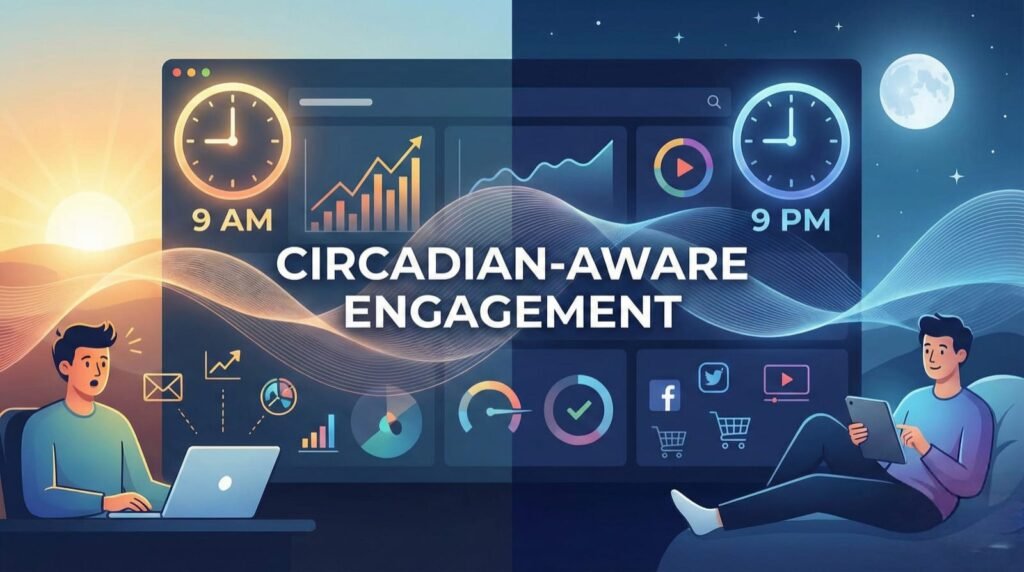
The core premise of Circadian-Aware Engagement is simple yet revolutionary: The same customer who is a decisive, analytical buyer at 9:00 AM may be an exhausted, passive scroller by 9:00 PM.
By aligning your marketing efforts with your audience’s biological clock, you can drastically improve open rates, conversions, and customer loyalty. This works because you are no longer asking the brain to perform a heavy cognitive lift when it is biologically preparing for rest, nor are you serving low-value entertainment when the brain is primed for deep work.
Consider the biological factors at play:
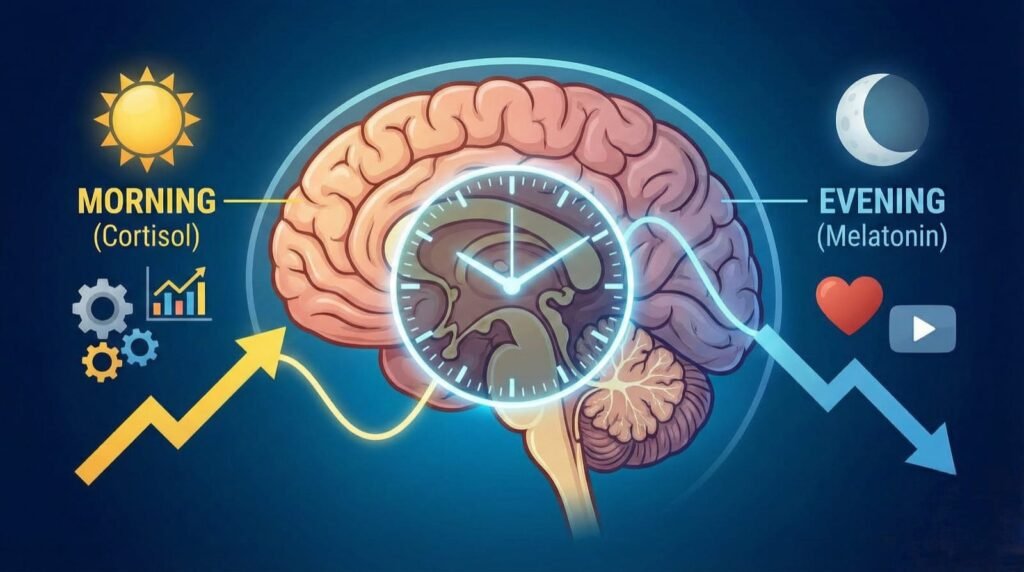
- Cortisol Spikes: Usually occurring in the morning, these drive focus and alertness. This is when users filter out noise and seek utility.
- Melatonin Onset: As evening approaches, the brain shifts gears. Critical thinking dampens, and emotional receptivity heightens.
If you send a complex B2B whitepaper during a melatonin phase, it gets deleted. If you send it during a cortisol spike, it gets read. That is the power of Circadian-Aware Engagement.
This guide will break down exactly how to leverage biological marketing to outperform your competition, turning the natural rhythms of the human body into your most powerful conversion tool.
What is Circadian-Aware Engagement?
At its core, Circadian-Aware Engagement is a marketing methodology that times interactions based on the target audience’s circadian rhythms—the 24-hour internal clock that regulates sleep, alertness, and hormone levels.
Unlike traditional scheduling, which might just look at “best times to post” based on global averages, this approach personalizes content delivery to when a user is biologically most receptive to specific types of information. For example, humans are generally more analytical in the morning and more creative or emotional in the late evening.

The Science Behind Biological Marketing
To master Circadian-Aware Engagement, you must understand the “Chronotype.” Everyone falls into specific sleep-wake classifications (often called Lions, Bears, Wolves, and Dolphins).
- Morning Peaks: Cortisol levels rise, making users alert and task-oriented. This is the prime time for “logical” marketing—B2B whitepapers, productivity tools, and news.
- Afternoon Dips: The post-lunch energy slump is real. Engagement drops for heavy content, making this ideal for low-effort entertainment or quick social updates.
- Evening Recovery: As the day winds down, emotional receptivity increases. This is the golden hour for lifestyle brands, storytelling, and impulse retail purchases.
By respecting these biological boundaries, brands stop being an interruption and start becoming a welcome part of the user’s day.
Note: Ignoring these rhythms results in “digital fatigue,” where users unsubscribe simply because a notification arrived during a high-stress biological window.
Top Benefits of Circadian-Aware Engagement
Why should you pivot your strategy toward biological marketing? Here are the measurable impacts:
1. Higher Conversion Rates
When you pitch a complex product when the brain is alert, the friction to purchase decreases. Circadian-Aware Engagement ensures your “Buy Now” button appears when the user has the mental energy to make a decision.
2. Reduced Churn
Sending high-frequency notifications during sleep cycles or deep-work hours is a fast track to being blocked. Respecting biological quiet times builds trust.
3. Enhanced Emotional Connection
Aligning emotional content with evening relaxation phases creates deeper resonance.
5 Strategies to Implement Circadian-Aware Engagement
Ready to apply this to your campaigns? Here are five actionable steps.
1. Segment by Chronotype
Don’t just segment by location; segment by behavior. Use email open-time data to categorize users into “Early Birds” (Lions) and “Night Owls” (Wolves). Most CRM tools allow you to tag users based on their habitual open times.
2. Tailor Content Type to Time of Day
- 6 AM – 10 AM: Send data-heavy reports, news, and task-based notifications.
- 12 PM – 2 PM: Share memes, light videos, and easy-to-digest social posts.
- 7 PM – 10 PM: Deploy emotional storytelling, shopping offers, and “wind-down” content.
3. Use “Send Time Optimization” (STO)
Many AI-driven marketing platforms now offer STO features. This automates Circadian-Aware Engagement by analyzing individual user history and holding a message until that specific user is most likely to open it.
4. Adjust Ad Bidding Schedules
Stop wasting ad spend at 3 AM unless you are targeting shift workers. Adjust your PPC bidding strategies to be aggressive during peak biological alertness windows for your specific industry.
5. Respect the “Do Not Disturb” Window
Never push promotional SMS or app notifications between 10 PM and 6 AM local time. Violating the sleep window is the antithesis of good Circadian-Aware Engagement.
Tools to Track Biological Rhythms
To effectively execute these strategies, you need data. Here are resources that help:
- Google Analytics 4: Use the “Time of Day” reports to see when your specific traffic converts.
- Mailchimp/HubSpot: Utilize their “Send Time Optimization” features.
- Oura Ring/Whoop Data: If you are in the health tech space, API integrations with wearables can provide hyper-accurate data (with user consent).
For more on marketing psychology, check out this guide on Neuromarketing Basics (External Link). You can also read our internal guide on Haptic Branding.

Conclusion
The future of digital connection is biological. Circadian-Aware Engagement is not just a trend; it is the logical evolution of user-centric design. By honoring the natural rhythms of your audience, you transform your marketing from a noisy distraction into a harmonious part of their daily life.
Start small: audit your email send times this week and shift your most analytical content to the morning. The results will speak for themselves.